
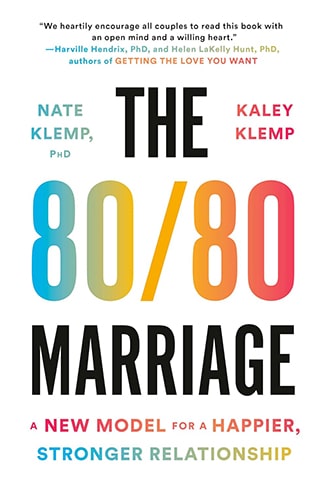
A lot of people go into marriage with a 50/50 mindset. Everything in the relationship — from tangible things like childcare and chores to intangible things like the effort and energy needed to keep the partnership going — is supposed to be divided equally.
The 50/50 approach to relationships is all about fairness. And that seems sensible and rational.
But, my guest says, it actually sabotages relational happiness.
Nate Klemp is a former philosophy professor and the co-author, along with his wife, of The 80/80 Marriage: A New Model for a Happier, Stronger Relationship. Today on the show, Nate shares how cognitive biases skew our perception of our contributions to a relationship, what happens when couples get stuck in the 50/50 mindset of domestic scorekeeping, and how shifting to an 80/80 model of “radical generosity” can create an upward spiral of connection and appreciation. And we discuss practical ways to divide household responsibilities, decide how much time to spend with each spouse’s respective parents, and establish values that will guide your partnership as you navigate life changes and work towards a spirit of shared success.
Resources Related to the Podcast
- AoM article and podcast on how to hold a weekly marriage meeting
- AoM Article: Towards a Philosophy of Household Management
- AoM Article: Beware the Tit for Tat Trap
Connect With Nate Klemp
Listen to the Podcast! (And don’t forget to leave us a review!)



Listen to the episode on a separate page.
Subscribe to the podcast in the media player of your choice.
Read the Transcript
Brett McKay: Brett McKay here. And welcome to another edition of the Art of Manliness podcast. A lot of people go into marriage with a 50/50 mindset. Everything in the relationship, from tangible things like childcare insures to intangible things like the effort and energy needed to keep the partnership going, is supposed to be divided equally. The 50/50 approach to relationships is all about fairness, and that seems sensible and rational, but my guest says it actually sabotages relational happiness. Nate Klemp is a former philosophy professor and the co-author, along with his wife, of the 80/80 marriage a New Model for a Happier, Stronger Relationship. Today on the show, Nate shares how cognitive biases skew our perception of our contributions to relationship what happens when couples get stuck in the 50/50 mindset of domestic scorekeeping, and how shifting to an 80/80 model of radical generosity can create an upward spiral of connection and appreciation. And we discuss practical ways to divide household responsibilities, decide how much time to spend with each spouse’ respective parents, and establish values that will guide your partnership as you navigate life changes and work towards a spirit of shared success. After the show’s over, check out our show notes @aom.is/8080. All right, Nate Klemp, welcome to the show.
Nate Klemp: So good to be here with you, Brett.
Brett McKay: So you co authored a book called the 80/80 Marriage with your wife, and in this book you both propose a new framework for thinking about marriage. And you start off the book with a story of what kickstarted the idea of the 80/80 marriage. Tell us that story.
Nate Klemp: Yeah, well, I’ll give you maybe even a more complete story than what we say in the book, which is to say that when we first got together, we had this fairytale, like, beginning to our relationship. So we met in high school. We were both seniors in high school. We were chemistry lab partners. We went to senior prom together. And then we pragmatically broke up before we went to college. And seven years later, it magically came back. We started dating again, we got married, and if you had asked our friends at the time, they probably would have told you we were like the perfect couple. And in some ways, that ended up becoming a trap for us because a year or two into marriage, as anybody who knows who’s been married knows, like, things got real. And for us, that looked like I was in my final year of getting a PhD, struggling to get a job as a professor. I had a serious bike accident. We were just locked into all sorts of conflict to the point where we almost got divorced at the time. Luckily, we didn’t we were able to push through that. But over the decades, it’s now been 19 years since then, we started to just ask this question, like, what was the fundamental essence of our conflict? And what we arrived at is that essentially we were fighting over whether it was fair and the it being all sorts of things like childcare and housework and finances and all the different things that go on in our life.
And so we decided to see were we the only people experiencing this? Were there others out there locked in this battle for fairness? And that’s what ultimately led us to write the book. And we interviewed a number of different couples, and what we found is that on some level, most modern couples seem to be stuck in this conflict over fairness for what is or isn’t fair. This practice of keeping an elaborate mental scorecard of all the wonderful things you do juxtaposed against all the things your partner doesn’t do.
Brett McKay: And, yeah, you call this framework of thinking about fairness in a marriage. You call it the 50/50 marriage. And on paper, it seems like that should be a good idea. But you found that it doesn’t work. It just makes things worse. Why doesn’t it work? Why does focusing on fairness in a marriage make things worse? Because people might be thinking, that doesn’t make any sense in a 50/50 marriage. You’re trying to be fair. And isn’t that a good thing?
Nate Klemp: Yeah, well, and. And this is so surreptitious. Like, it’s happening all the time, mostly under the radar of awareness. For example, just the other day, I think it was last night, actually, I was unloading the dishwasher, and I thought to myself, man, this is like the third time in a row I’ve unloaded the dishwasher, and I could feel the agitation. And. And that’s just a micro example of how this shows up. It’s this thought things aren’t fair, which is then followed by some experience of anger or resentment. And the reason this doesn’t work, it’s actually kind of interesting. There’s this, like, really cool science coming out of the field of marriage research, where they do these time survey studies. And they found a couple things. The headline here is that we’re basically really bad at assessing what is or isn’t fair. So if you’re saying, man, I contribute 60% or 70% to my relationship, that number is based mostly on pure delusion. And there are, like, two things that contribute to this. One is what psychologists call availability bias, which is basically just A fancy way of saying, in my marriage and my relationship with my wife, Kaley, all of the wonderful things that I do, like all those contributions are available to me.
I see them happening in real time when I’m taking our daughter to her violin lesson or whatever it might be. When it comes, though, to what Kaley’s doing, all of a sudden things get a little bit blurry and foggy, like she’s contributing. But I don’t really see any of that happening in real time. And most of it I don’t see happening at all, and I don’t even know about it often. So there’s this tendency, then, to systematically underestimate what our partner is doing. You add on top of that, one other cognitive bias, the overestimation bias, where they found in researching couples that people tend to radically overestimate the amount of time they spend on household labor and on childcare. So what that means is if I say, like, hey, I spent an hour yesterday cleaning up the kitchen. It was probably more like 30 minutes. And you put these two together, and you start to see, okay, we’re systematically underestimating what our partner does. We’re systematically overestimating what we do. And then we’re having this conversation about trying to make things fair. And you start to see that the numbers are just based on delusion. And that’s why we think this idea, this mindset of 50/50 fairness just doesn’t work, and it leads to perpetual, constant conflict.
Brett McKay: Yeah. So we’re keeping a mental scorecard when we have a 50/50 marriage. But the problem is the scorecard is probably not accurate.
Nate Klemp: Yes. Wildly inaccurate is the way I would put it.
Brett McKay: Yeah. And you talk about some of the reoccurring problems or conflicts you see in couples that you interviewed when they try to do everything. 50/50. You mentioned one in your own marriage, the domestic scorekeeping fight. It’s like, well, man, I’ve done dishes three nights in a row. What’s going on here? What are some other common areas in a marriage where people try to do things? 50, 50. And it just causes a lot of tension.
Nate Klemp: I’m so glad you asked that, Brett, because it was really interesting when we would ask couples, do you fight about fairness? Most couples said, no, we never have a fight like that. And then we would ask them about things like who does the chores around the house or money, and they would reveal all of these different conflicts that were, in essence, conflicts over fairness. So that’s what I was saying earlier. Often this is happening beneath the Radar of awareness. So seeing the kind of classic archetypes of this fight can be really useful just as a way of cultivating awareness. So, yeah, you mentioned domestic scorekeeping. That’s one way it shows up. Another way it shows up often for couples is trying to make the balance of time spent with each extended family or each set of friends equal. So, for example, in our life, we used to live in Los Angeles, and we’d come back to Colorado, where both sets of parents lived for the holidays, and we would have these epic, explosive fights over trying to figure out the right balance of time spent with my family and then spent with Kaley’s family. And many couples that we’ve interviewed have something similar going on.
There’s also a fairness fight for many couples around money. So a lot of couples fight over who’s saving more, who’s spending more. And then another way this shows up, especially with couples who have children, is as anyone who knows who has a kid, once you have a kid, all of a sudden free time and leisure time becomes like, we like to call it domestic gold. It’s this insanely scarce resource. And so we were interviewing one woman, and she was telling us about how she went to Target. Right. And she spent an hour at Target, and she got home and her husband was like, oh, cool, you had your hour of free time. Now I’m going to go to the gym. Which of course, triggers this huge fight over again, this balance of the amount of leisure time that each person in the partnership gets.
Brett McKay: Yeah. And for the wife, she. She’s probably a Target. Not for leisure. She’s probably buying stuff for the house. So, like, for her, it’s just a chore.
Nate Klemp: Exactly. Yeah. For her, it was a chore. And that was the essence of the fight that she was talking about, is that she’s like, that wasn’t leisure time. Like, that was me buying a bunch of crap for the family. Are you kidding me? And you can imagine then how that fight would ensue from there.
Brett McKay: Yeah, the 50/50 split on time with in laws or family. I remember when we first had kids, that. That can actually get exhausting. Because you do try to be fair because you want your parents to see the kids and you want your wife’s parents to see the kids. But then trying to do two Christmases in one day, it was exhausting. Just, like, wore you out. I mean, we were fair, but in the end, it was like, I’m tired. That was not fun.
Nate Klemp: It’s funny that you mentioned that we had a similar experience I’ll never forget it. We were. Had just gotten through the holidays, and our system was my parents got Christmas Eve and Christmas, her parents got the next four days because they didn’t get the real holiday. They got a bonus two days after. And we got to the end of that one year. And I remember we had the same experience of just, like, this is exhausting. Like, this is just torture.
Brett McKay: Yeah. And what’s interesting is that everyone’s definition of fairness is going to be different because everyone’s got a different calculus going on in their head. So you’re like, well, we didn’t get to spend Christmas Eve and Christmas with my family, so we get to add an extra two days. And then the other person’s like, well, no. Why would we do that? I only got to spend two days with my family. So you only get to spend two days with your family. Like, that’s fair.
Nate Klemp: Yeah. Well, and what’s also interesting is that it’s not just you and your partner generally. The families are also in on the whole game. Right. There’s a lot of guilt and a lot of pressure coming from each set of families or each set of parents saying, like, hey, we need you. How could you miss Christmas this year? So it becomes this very complicated thing to navigate.
Brett McKay: Yeah. And this can also happen with friends, too. It’s like, well, we spent time with your friends. Now it’s time to spend time with my friends. And then there might be this negotiation that goes on back and forth and just causes conflict.
Nate Klemp: Yeah. And I think it’s just important to mention here that there is nothing inherently wrong with this effort to achieve fairness. I mean, it really is a noble goal, but the problem is that it can become such a pervasive mind state that it really starts to pit people in relationship against each other, and it starts to create a culture in a relationship that’s very individualistic. That’s very me versus you, what I want versus what you want. Right. It. It kind of turns the relationship into a negotiation which ultimately isn’t very loving, isn’t very sexy. So that’s why I think it starts to break down for most couples.
Brett McKay: And one of the things that heightens the conflict over fairness In a modern 50/50 marriage is that there’s a lot of role confusion. When you talk about this in the book, like in an older model of marriage, like a 1950s model of marriage, it had its downsides, but it also had its benefits in that everyone knew what they’re supposed to be doing. It was like, well, mom, does this. Dad does this. And there was no confusion. Now, today, most people, they want a more egalitarian relationship. Both spouses might be working, Both are taking part in childcare. But then the question becomes, okay, well, how. How do we divvy all this stuff up? There are any set roles, and they’re just kind of winging it, and then this just causes all this conflict.
Nate Klemp: Yeah. So one of the big shifts to our current state of relationships and this mindset of 50/50, is that we are now both equals in this relationship. And that means we’re both equally capable of being a rock star or an amazing scientist. But it also means that we’re both equally capable of cleaning the dishes or unloading the dishwasher or doing the laundry. So what that creates, to your point, is this state that we like to call role confusion, where it’s like, wait, we could both be doing all of these different things, so whose job is it to do them? And when we would interview couples about this, it was really interesting because we’d ask them how did you decide on your structure of roles in your relationship? And basically, everyone we talked to had the same reaction. They kind of looked confused for a moment, and then they said some version of, I don’t really know. I guess we just are kind of winging it. And we actually started to call this the wing it approach to roles, which is the standard approach that most couples take to creating a structure of roles.
You know, one guy I remember I talked to, he was like, somehow I’m the toothbrush guy with our daughter. Like, every night when it’s time for us to put her to bed, I’m the guy who brushes her teeth. I don’t know how that happened. I don’t know how I ended up in that role, but that’s just, like, the role that I ended up in. And there’s not necessarily anything wrong with this accidental approach to roles, but we think there’s a better way to think about this, and that is this shift from accident to something more like design to actually having a conversation with your partner. And most couples have never done this, where you take a step back and you say, like, hey, let’s look at the structure of what we do. Let’s look at what we enjoy doing, what we don’t enjoy doing, what we’re good at, what we’re not good at, what we might be able to outsource, and let’s actually, like, design this thing to work for us. So that can be a huge thing for most couples to do.
Brett McKay: Yeah, we’re going to talk about some questions you can ask to figure this out. But before we do, let’s talk about the 80/80 marriage. So you and your wife proposed. Instead of looking at marriage through the rubric of 50/50 fairness, we need to have an 80/80 marriage. So what does an 80/80 marriage look like?
Nate Klemp: The first thing you’ll probably notice is that the math doesn’t work. There’s no such thing as a 160% hole. That’s just a mathematical impossibility. But the basic idea behind 80/80 is shifting the expectation or shifting the goal from just doing your 50%, which locks us into that mindset of fairness, to striving to contribute at something more like 80%. And that’s a mindset shift from what we call fairness to what we like to call radical generosity. And we know that it’s not going to work. Right. There is no way that you and your partner can both contribute at 80%. But it’s kind of this radical, illogical goal that’s really meant to uproot this habit in our thinking that most of us have developed. And the idea is that if we approach our life and our marriage together with this goal of striving for 80%, all of a sudden we start to radically change the underlying culture of the relationship. And I will say here that usually when I get to this point, there are many people who start voicing objections, like, wait a minute, you’re saying I should do 80%. That is just a recipe for my partner to totally take advantage of me.
Why would I do that? And so I think there’s a really important response to that objection that I just want to get to briefly, which is we like to say, and this is validated by psychology, that your mindset is contagious. So if you’re operating in that 50/50 mindset where there’s a lot of resentment and a lot of anger and a lot of scorekeeping, your partner will generally mirror that back to you at every turn. You’ve created a kind of contagious atmosphere of resentment. If, on the other hand, you and just you shift to something more like the 80/80 mindset of radical generosity, that is also contagious. Your partner might be like, what is happening? Are you on drugs? Like, did you go to a yoga retreat? What is wrong with you? But what also tends to happen is that your generosity opens up a space for your partner to also be a little bit more generous, and you can start to create this Virtuous Upward Spiral.
Brett McKay: Yeah, the 50/50 mentality can get you stuck in a tit for tat trap. It’s like, I’ll do this if you do that. And if that’s how you approach the relationship, your spouse is going to. Is going to start syncing up with that pattern you set up, and it just becomes this vicious downward cycle. And it. And it’s all just unsolvable conflict. Try to make things exactly fair, because how do you decide if work done outside the home is weightier than work done inside the home or if this chore is harder than that chore? I mean, it’s, it’s all just unsolvable conflict. So instead of trying to make your responsibilities and contributions mathematically equal, just operate with an attitude of generosity, and then that can become contagious. It’s like, well, if you do that, then your spouse will see it and she’s like, oh, wow, he’s doing a lot. I appreciate that. I’m going to do something for him. And then it becomes a positive tit for tat.
Nate Klemp: Totally. And it’s kind of a fun experiment to do. If you’re listening to this podcast and it’s just you without your partner, try the experiment of taking a day or a week where you just really consciously start to live into this mindset of radical generosity and just see if your partner’s behavior doesn’t. Doesn’t change in subtle ways. We call it, like stealth 80/80. It’s a fun experiment to try.
Brett McKay: And one of the big takeaways I got from the idea of the 80/80 marriage, or the overarching principle, is that it’s about, if I win, we both win, or if you win, I win too. It’s like you see your marriage as a team effort, whereas the 50/50 marriage, you’re mostly thinking like, well, what can I get out of this relationship? Like, how can this marriage help me become a better me? Which, I mean, marriage can do that, but like, that, if that’s your goal, then you’re just going to get stuck in this. These tit for tat traps. But when you kind of approach it from like, hey, we’re on the same team. What can we do so that we can both succeed? Everything just goes so much more smoother.
Nate Klemp: That’s exactly right. I mean, it’s really interesting that many couples do get stuck in this trap of basically thinking, like, what can I do for me? How can I stand up for number one here? And I don’t think it’s an accident that this happens. You Know, we are raised in a culture that celebrates individual excellence. For me and Kaley, we went to college, and the message we received was, you need to do something amazing. You need to achieve success as an individual. And so then we got married, and the expectation becomes, okay, now you’re supposed to shift from individual success to this collective project together where you’re sharing your life and your space and your money. And that shift is really radical. And most people aren’t really able to make that shift quickly. So that’s where there is this more conscious effort that I think we all need to make in our relationships to see if we can shift the emphasis in our own thinking from individual success or how do I win alone, how do I win in my career, in my life, to a goal that’s more like shared success. How do we win together?
Brett McKay: Yeah, I love that because, like, sometimes it might mean one person gets to achieve, like, their personal goal because it helps the family out in the long run. And then sometimes it means the other person gets to do that. And, like, you just, maybe you take turns. It’s not like fairness, but it’s just like you kind of intuitively know, okay, well, it’s time for me to do this thing, or it’s time for you to do this thing. Let’s marshal the our resources. We make this happen. And then it can change as the relationship progresses.
Nate Klemp: Exactly. Yeah. You can alternate between whose background, who’s foreground. And that’s a really cool thing to do. Kaley and I do that a lot. You know, if I’m writing a book, I’m foreground. When it comes out, if she’s doing a big engagement, she’s foreground and I’m background, kind of holding the house together and our daughter together. And so that alternation can actually be really quite fun and just a way to grow together. And I would say, like, the main shift to try to aspire toward is when your partner has a big win, even if there is, like, a little tinge of jealousy or envy, which happens in a lot of partnerships. See if you can really celebrate that, because ultimately, if your partner wins big, that is a win for both of you. And so. So it’s like that shift of just trying to celebrate the wins together rather than as individuals.
Brett McKay: As I was reading about the 80/80 marriage, it made me think about pioneer days in America, like living out on a farm on the prairie. You know, back then a couple had to be this real unit the husband and wife. They had roles, the kids had roles. Everyone had responsibilities. But everyone pitched in with everything. I mean, if one person couldn’t do something, then the other person had to pick up the slack. It wasn’t about fairness. It was just like, okay, what do we need to get done to survive? Let’s all work together here.
Nate Klemp: I love that. It’s actually funny. I was just interviewing a couple in Australia. We’re writing a new book on busyness and love, and they were farmers in rural Australia, and they were basically living what you described. Like, the guy was telling me his calves had pink eye, and they were out there trying to get the pink eye treated while they were feeding the calves and getting them ready for taken down for purchase or whatever it was. And it’s a cool analogy. The other analogy that I really like here is if you can imagine your family as something like a business. We like the name Family Inc. For this. In fact, this was something we ended up cutting from the book. But the reason I think that’s helpful, and some people resist that because they’re like, no, it’s about love and spontaneity. And I don’t want to think of my family as a business. But what’s helpful about that is just thinking, hey, if we were a kind of collective business, then it doesn’t really matter who’s making more money or who’s achieving more success. What matters is that we’re lining up what we each do such that we maximize the success of the collective enterprise.
And that’s a really different way of thinking of it. You know, we also use the analogy of basketball sometimes, right? Like 50/50 is kind of like playing basketball where you and your partner are on the same team technically, but you’re both trying to drive up your stats and maximize your individual numbers, win the MVP award or whatever. Whereas when you shift to 80/80, the goal is just like, how can we win this game? And if that means that I’m shooting more three pointers than you are, that’s okay, right? If that means you’re passing more or I’m passing more, that’s okay. It’s a very different way of thinking about a partnership together.
Brett McKay: We can even go further back. I like this business analogy. So if you go back to the ancient Greeks, Aristotle, he talked about household management and our word economics oikos, comes from that. But for the Greeks, it wasn’t like economics, like businesses and countries trading for them. Economics was centered in the home. And so he wrote a lot about, like, how do you manage a home properly so that everyone in the family can flourish? And so he talked about there’s. There’s a lot of practical stuff when it comes to home management. You have to manage resources, know where your stuff’s at. You have to think about the income coming into the household so that you can buy things, that you can continue to grow the household. But then also part of economics or home economics for Aristotle is it was like, how do we rear our children so that they can become productive, active participants in Athenian democracy? So I like that idea because the husband and wife. And for Aristotle, there was a lot of gender disparity, of course, because, like ancient Greece. But he did see the husband and wife, they had to work together on this thing to make sure the home had good oikos or good economics, so you could achieve this eudaimonia, or flourishing for the family.
Nate Klemp: Can I just say, you talking about Aristotle is like the highlight of my year so far. I don’t know if you know this, but my background is in political philosophy. That’s what I got my PhD in. And my wife actually cut. I had some passages on Aristotle that I was going to put in the book, and she’s like, nobody cares about Aristotle. We’re cutting that. Right. So that was one of our conflicts in the book. But to get to the content of what you were saying. Yeah, totally. And the other piece of Aristotle that I think is really interesting here is if you think about his conception of the ideal political regime he was the one who came up with our typology of monarchy, oligarchy. And what was his other name for it? Polity, I think was the. Or democracy, I guess was the third one.
Brett McKay: Democracy yeah.
Nate Klemp: And as I recall him, the key distinction between good and bad regimes in politics was really about is this focused on the individual’s interest or is this focused on the common good? And I think that’s another way of thinking about what we’re trying to aspire toward here. In the 80/80 model, in 50/50, we are focused on individual interest, individual success. It’s all about me. But when we shift to something more like 80/80, we’re looking at, like, the common interest. How do we win together as a collective, the two of us? Or if we have kids, maybe it’s the three, four, five of us.
Brett McKay: We’re going to take a quick break for a word from our sponsors. And now back to the show. Okay, so let’s talk more about the 80/80 marriage. You say there are three elements to an 80/80 marriage. What are those three elements?
Nate Klemp: Yeah, so that mindset of radical generosity is kind of an overarching term for a way of thinking about the world, a way of seeing the world. And the question then becomes, how do you operationalize that? If you just say I’m going to be radically generous, that doesn’t really give you much to do practically. So the three pieces to this, the first is about what you do, and that’s contribution. Contribution is really in many ways the essence of generosity. And I like to think of contribution in a marriage. The most useful forms of contribution as these small micro acts that are just reminders to your partner that you’re thinking about them, that you care about them, that you love them. So it’s great to like get your partner a trip to Fiji or get them concert tickets for some amazing artists. Those big acts of contribution are fine and definitely useful. But the essence of contribution is really about what are the daily acts of contribution you can do that are small but significant in terms of building connection. So things like writing I love you on a post it note, putting it on your partner’s computer, things like just getting them a cup of coffee in the morning, filling their car up with gas. Right. These are very simple things.
Brett McKay: Yeah, the filling up your car with gas. So a long time ago on our website when we had comments, someone left a comment. This is like 15 years ago. It was like always fill up your wife’s car with gas to bless her. And so I always, that stuck with me for some reason. So I’ll. Whenever I see the, the car it’s almost empty. Like I got to bless my wife. Going to, going to go fill up the car with gas at QT.
Nate Klemp: I love that. Yeah. And it’s just like such a simple thing. It takes you what, five minutes on your way home?
Brett McKay: Yeah.
Nate Klemp: But it’s just one of these actions that reminds your partner, like, wow, there’s a spirit of love happening here. So that’s the first one. The second piece is appreciation. And we like to think of this almost like the response to the call of generosity. So in music there’s this idea of call and response. And generosity is an amazing thing. It’s a contribution. But it often is sort of asking for some sort of response. And that is what we call appreciation. The other thing I would say about appreciation is that this is really counter habitual that most of us have this tendency of seeing our partner through the lens of what they’ve done wrong. Seeing where they fell short or seeing where they didn’t quite do what they said they were going to do. And appreciation is basically just flipping the glasses that we wear in our relationship so we’re actually looking for what our partner did. Right. And then we’re expressing that, like, hey, I noticed that you did this amazing thing with our kids. You took them out yesterday afternoon and took them on an adventure. Thank you. Right. So that’s the act of appreciation.
And there’s all sorts of research in the field of marriage science showing that appreciation is perhaps the most powerful thing you can do to create more connection in your relationship. The final thing, the third piece of radical generosity is what we call revealing. And what we mean by revealing is basically just expressing your full truth in your marriage. There’s two sides to this. So on one side, it’s expressing what’s happening in your inner world. So there was this interesting study they did at UCLA. They found that the average couple with kids spends 35 minutes a week talking to each other. And they didn’t really study what they were talking about, but if I had to guess, they were probably talking about logistics or, like, the news or the weather. And so one aspect of revealing is just shifting the way you talk to one another, such that when you’re at the end of the day updating each other on your day, you’re revealing what’s actually happening in your inner world, like, what’s really going on with you. The second piece to revealing is when you have those moments of disconnection or misunderstandings or somebody’s feelings got hurt, using that as an opportunity to reveal as a way to get closer. And that’s not that easy to do for most couples, but it ends up being really powerful. If you can start to transform those moments of disconnection into opportunities to get closer.
Brett McKay: How do you reveal that second thing? Because oftentimes, if you try to tell your spouse, like, hey, you did this, it can just. It’s an opportunity to get resentful.
Nate Klemp: Yes.
Brett McKay: Any ways to do that where it doesn’t cause more bad feelings?
Nate Klemp: Yeah, absolutely. And this is another one of those areas where we want to see if we can shift from our accidental habits, which mostly aren’t that skillful, to a more skillful way of approaching it. So let’s say Kaley’s late for dinner. She said she was going to be there at 6:00, and she’s not there till 6:15. The actual dental way of approaching that is. Is for me to just lash out at her, Right. To just Be like, are you kidding me? I’ve been sitting here for 15 minutes. Like, who do you think you are? You think you’re more important than I am? Right? And you can imagine I could continue that conversation. She’ll get defensive, we’ll get in a big fight, It’ll be a terrible dinner together. So that’s kind of how things go down by accident. What we recommend is an approach that we call reveal and request. And the basic idea is to start by just revealing what we like to think of as your inarguable truth. So what’s really going on with you? What emotion are you feeling in that moment without blame? Just like, hey, I’m feeling X. And then offering some sort of request for how they might be able to make it right in the future.
So that would look something like, hey, I’ve been here for 15 minutes and I noticed that I’ve just been feeling kind of frustrated because you didn’t text me to let me know that you were late. In the future, would you be willing to just send me a text if you’re going to be 15 minutes late? So it’s a pretty significant difference if you just start to think about how the other person’s going to respond to those two approaches.
Brett McKay: Okay, so 80/80 marriage. The overarching principle is radical generosity. It’s like, hey, we’re a team. If you win, I win. Three attributes. It’s contribute. So find little ways you can contribute to your wife throughout the day. It could be small things. Fill up the gas tank, write her a note, pick up her favorite drink from QT on the way home. Show more appreciation throughout your week, and then reveal. So could be problems that are coming up. Or reveal. Hey, this is what I’m doing. This is what’s stressing me out. Here’s what I’m thinking about. Let them know. One thing you talk about too, in sort of being more intentional about creating a culture in your marriage is establishing common values for the family. Just like any team or any business. I love this business analogy. They have a mission statement, for example, that guides all the actions within the business. You argue a family, a marriage should also have something similar. So how do you recommend couples establish sort of this overarching mission statement, or going back to Aristotle, an overarching telos for the family?
Nate Klemp: Yeah, the family telos. I like the sound of that. Yeah, absolutely. That’s a really important thing. And it’s really interesting actually to notice that almost every business has a very clear set of values and yet most relationships don’t most relationships are winging it, doing it by accident. So we think that’s really important. And it was interesting, actually, when we had all of these interviews with various couples, what we discovered is that there are no better or worse values for a marriage. So the expanse of different possibilities is really wide. We would talk to some couples where their value was adventure. So there was one couple we talked to, they basically lived out of a van for seven years and just drove around the country, going to different national parks and having adventures. That was their value, and they were aligned on it, so it worked for them. Other couples were more concerned with things like building wealth or security. And you could imagine if you took a partner from the wealth couple and you put them in the adventure couple, where they had, like, quit their jobs in New York and were living out of a van, they totally freak out.
But all that’s to say values aren’t better or worse. What is a problem is when you’re in a relationship and you’re not aligned on your values. That’s where a lot of conflict comes from. So we think it’s really helpful to just sit down and think about as a couple. What are the three to five values that we want to guide our life together? The way we parent, the way we show up with each other, the way we show up at work. We think it’s really cool, once you’ve done this, to actually make an artifact out of it. So we have our values right on the outside of our kitchen table on another counter, and we put them on a little whiteboard. And so it’s something we see all the time. And I think that’s important because some couples will actually do an exercise like this. They’ll come up with values, and then the values won’t actually be used in their relationship. So you want to see if you can use these values for, like, big decisions around money or big decisions around your career. And what’s cool about that is instead of getting into that trap we’ve been talking about of what’s best for me versus what’s best for you, values give you a different way to make decisions.
They give you a kind of rubric for running your life decisions through, where it’s like, well, in terms of that career move, what’s going to align most closely with our values? That’s a really different question than what’s best best for me versus what’s best for you.
Brett McKay: And these values or this telos, it can change as the family progresses or as the marriage progresses. So Keep having that conversation about your telos and your marriage and your family. It’s an ongoing thing. Make sure it’s front and center there as you’re making decisions that affect the entire family. Let’s talk about some more brass, tax things. So we talked about one of the biggest sources of contention in a 50/50 marriage is role confusion. No one knows who’s supposed to be doing what. There’s a maybe a sense of unfairness and how things are divvied up. You mentioned most couples, the way they divvy up roles in a marriage, to wing it just sort of like, I’m the toothbrush guy for some reason. I don’t know why I’m toothbrush guy, but I’m toothbrush guy. Or you’re the grocery person. Any advice on how to be more proactive in assigning roles in a marriage so that it’s a win-win for everybody?
Nate Klemp: Absolutely. We actually in the book have a pretty elaborate practice that you can walk through with your partner. But here’s the shorthand version of that that you can do. It’s as simple as take a couple pieces of paper and step one is just write down all of your roles as individuals. And this is a really interesting step because a lot of times we’re not even clear on what our roles are. Right. Like, most couples couldn’t tell you really quickly off the top of their head, hey, yeah, I do these 20 different things. So that exercise is really important. There’s a trap there, which is there can be a tendency when you write those down to start to get into that fairness mindset and compare. Wow, like, your list is really long and my list is really short. This is unfair. That is not the goal at all. Right. The goal in that first stage is just like, get it all down on paper, create awareness of what’s happening today. And then the second step to this is get out two more pieces of paper and have a conversation about, hey, like, if we were to actually design this and not just do this by accident, what are the things you enjoy doing? So, for example, I have like a weird enjoyment for taking the trash out.
It’s just not a thing for me. My wife has an enjoyment of folding laundry and doing laundry. It’s just like not a thing for her. So those are obvious no brainers. Like, those should be on each of our respective lists. But that can be a useful process because you start to ask, well, what am I good at? What do I enjoy? And then importantly, what can we outsource? So for some couples There are things that nobody wants to do. Like in our house, nobody wants to clean the toilets. And we’re fortunate that we have the resources that we’re able to bring somebody in once a week who helps us clean our house. And it’s amazing. And actually in our budget that’s under, like marital, like a contribution to marriage, not cleaning. I mean that’s, that’s how we think of it. Like this is a contribution to us because it saves us from all sorts of conflict and fights around who’s going to clean the toilets.
Brett McKay: No, I love that we’ve done that in our own family. Like for me, a weird one. I like going to the doctor’s office or the dentist’s office. I don’t know why I like doing it. Like filling out the forms.
Nate Klemp: Yeah.
Brett McKay: And so I’m the guy, I’m the one who takes the kids to the, the dentist and the doctor and make appointments for them. That’s my, my wife hates it. She hates going to the doctor, hates going to the dentist. [0:40:13.0] ____ I’m like, hey, yeah, I’ll take that one. It’s great. So I like that. So talk about what you’re good at, what you enjoy, and then delegate. And that delegate piece you talked about, this is really important because sometimes what often happens, let’s say your wife delegates something to you because it’s important to her, but she doesn’t have the time for it or something like that. But then you just keep putting it off and you have these check ins. Your wife’s like, hey, have you done that thing? You’re like, no. And the reason why you don’t do, it’s like for you it’s just not that important. It’s like, I just don’t, it’s not that in the grand scheme of things and important, but it’s important to her. And that can be a big source of tension because, like it’s really important to her. And it feels like you’re disrespecting her because you’re not doing it because it tells her, like you don’t think it’s important either. So the solution to that is just outsource that to somebody else, like a third party so it gets done.
Nate Klemp: Yeah, if it’s possible. That’s such a great solution because you can have a conversation that goes like, hey, I know this is really important to you. It’s hard for me to complete for whatever reason, or it’s not very important to me. Can we bring somebody else in who can help you? You know, like in our house. My wife is really like, it’s important to her that our yard looks really good and I could care less. And I hate mowing lawns and all that sort of thing. So that’s one of those areas where it’s like, I want to honor that. It’s really important to you that our yard looks great. I also just like, that is not on my priority list at all. So maybe we can see about getting somebody to come in and help us with that.
Brett McKay: One issue you talk about in a marriage, that can be a source of conflict. And the 80/80 approach to marriage can help with this is this idea of over functioning and under functioning. What is over functioning and under functioning? How does that cause conflict?
Nate Klemp: Yeah, this is a dynamic that shows up in a lot of relationships where there’s an over functioning or over contributing partner, statistically speaking, that’s probably usually the woman, but that’s not always the case. And then there’s also often an under functioning or under contributing partner, which statistically speaking is often the man. And a couple things about this. First of all, it seems like it would be awesome to be the under functioning partner, the under contributor. But I was that partner in our marriage for probably a decade. I’ve interviewed a number of people who have found themselves in that role. And what I hear consistently is that it actually sucks. Like you think, oh, it’s cool, I don’t have to do as much. But it sucks to be in a position where it feels like you’re not actually contributing. Nothing you do is right. And so what often ends up happening is there’s a gap between how much each of these partners is doing. The under contributor feels like nothing I do is right, so I’m just going to stop doing anything. So the gap just starts to widen and widen and widen. And when you approach that kind of a distinction between over contributing, under contributing partner from a 50/50 mindset, it actually makes the inequality grow, paradoxically because like the more the over contributor is begging the under contributor to contribute, the more they just sort of pull back, the more they withdraw, the less they do.
So that strategy just doesn’t really work very well. What does work we found is for the under contributor or the under functioning partner, there’s a responsibility there to really see if you can lean in and see if you can contribute, knowing that you might do it wrong, knowing that it might not be perfect. But then the more interesting role is for the over contributor, the over functioning partner. A lot of times they’re stuck in that position unconsciously because there’s like this weird gift that comes from being the over functioning partner, which is that you have control. Like, you know when all the play dates are where all the money goes, you know that you’re getting the right brand of dishwasher cleaner from the grocery store. And so from the perspective of the over contributor, the unlock there is you actually do have to start letting go of control. And your partner might do it wrong, they might get the wrong thing at the store. But that’s kind of like the movement of each partners that you have to make to start to dissolve that dialectic between the two.
Brett McKay: Let’s circle back to something we talked about earlier that I know caused a lot of tension in a marriage. And that’s how to decide whose family to spend the holidays with or how often to visit each spouse’s parents and stuff. Do you have any advice on how to navigate that conflict?
Nate Klemp: This is such a huge source of tension for a lot of couples. Certainly it has been for us. I think the first thing to notice is that many times when we’re having this argument, we’re having this argument as our parents, kids. What I mean by that is we’re having the argument from the perspective of I’m my parents, kid, my parents really want to spend time with us. We need to make sure that the amount of time we spend with my parents and with your parents is fair. And what that does is it totally takes out of the conversation what’s best for you and your partner. Right. And so there’s almost like a shift here from being your parents kid to being the adults. And if you approach this question from the perspective of, hey, now we’re the adults, then I think there’s a really different perspective, which is rather than thinking of this question of how are we going to divide the holidays from the perspective of what’s best for our parents, like, how do we make our parents happy? How do we be good kids? To shift to a different question, which is what’s best for us as a couple? So in other words, you’re putting your priority on you as a couple rather than on pleasing your parents.
And when you’re able to do that, all of a sudden the answers might really change to these questions. So for example, you might say, hey, yeah, let’s go back and visit our parents, but let’s stay in a hotel this time, or let’s make sure that we have a few hours every day that’s for us. You might also notice that from that perspective, you actually end up with A somewhat unfair solution, like you may voluntarily say, hey, let’s actually spend less time with my family, because that’s not what’s best for us. So there’s a way in which you can make that fairness fight almost dissolve by just shifting the priority from what’s best for your parents and how do we satisfy them to what’s best for us as a couple and really stepping into that position of we are the adults, we get to decide what’s best for us.
Brett McKay: I like that. I imagine that’s a tough shift for people to make.
Nate Klemp: Yeah. And I think particularly early on, Kaley and I got married when we were 26, and we really took on the role of our parents, kids. And that caused so much conflict between the two of us because it was almost like we were each the representative of our respective family. And we were having these fights where we were sort of like the proxy representative for our family. And that started to dissolve the moment we said, wait a minute, we’re actually the adults here. We’re going to create our own life. We’re going to do what’s best for us. And that doesn’t mean we’re never going to visit our parents. Doesn’t mean we don’t care about our parents. Just means that we’re going to act like we are adults and autonomous rather than being our parents, kids.
Brett McKay: So at the end, you talk about some rituals that you can take part in to sort of bolster this 80/80 marriage. What are some of those rituals that you recommend?
Nate Klemp: Yeah, we have five essential habits that I think are worth trying out as a way to just build habits of connection versus habits of disconnection in your relationship. And they’re all based on this idea of living in a more 80/80 structure and mindset in your relationship. So the first one is just creating more space for connection. I mean, when I talk to couples these days, the primary thing I’m seeing is that there’s no space. And so thinking about ways where you can have space together as a couple. And we think about this in three ways. One is just like daily micro habits of connection, some sort of check in every day. Another is having some sort of medium habit of connection. So it might be going on a date night or going on a date hike. That’s our favorite, like something you do every week. And then there are more macro habits of connection where maybe you take a weekend together once every quarter, once every year, maybe you go away for a week. So that’s number one. The second is what we’ve been talking about throughout the podcast, which is this idea of really leaning into radical generosity, so contributing that whole idea of daily acts of contribution.
They can be really small, seemingly insignificant, but then also creating a habit of appreciation. My wife and I, we do this every night before we go to bed. It takes like three minutes. It’s just like such a great way to end the day. The third thing is what we were talking about with revealing. So when issues arise, revealing what’s going on for you, revealing that you’re feeling that disconnection and seeing if you can turn those into opportunities for connection. The fourth piece is what we call the shared success check in. So this is basically an idea of having some sort of. Maybe it’s a weekly or a monthly check in where you’re able to talk through all of the complicated logistics of your life, think about what’s working well, what’s not working so well. We found that couples that do this, they save date night from being all about logistics because if you don’t do this, then you end up on date night or whatever your time together is, and you’re talking about, like, who’s going to pick up the kids next week. And then the final piece is creating space from digital distraction.
And this I think is really important because when I talk to a lot of couples these days, what I hear is not that they’re in like, really deep conflict or they’re having affairs or things like that, but there’s this, like, subtler force of disconnection where they’ll talk about. At the end of the day, one of us is sitting on one side of the bed going through Instagram. The other person is doom scrolling the news. And there’s this way in which our devices are just like subtly pulling us away from each other. So really seeing if you can create those spaces from digital distraction. Maybe you kick your cell phones out of your bedroom, maybe you kick them out of your dinner, maybe you buy a case safe so you can lock them up for like two hours at night. Whatever you need to do. That can be like a really powerful unlock.
Brett McKay: No, I love that. A ritual that my wife and I have been doing for a long time now. And we’ve talked about this on the podcast before. We’ve written an article about it. But it’s been a game changer for us. And I know the people who have done it has been a game changer for them. It’s having a weekly marriage meeting.
Nate Klemp: Yeah.
Brett McKay: This was introduced by this marriage therapist named Marcia Berger. And you have this Meeting once a week. And there’s a few parts of the meeting. The first part is you spend time appreciating each other. So you just talk about all the things that you noticed throughout the week that your spouse did. Appreciate that, hey, I saw that you took the kids to this thing. I appreciate you doing the laundry. I appreciate you, whatever. And then you do to do’s. So you talk about all the stuff that you have to do in the household just to make sure the household’s running smoothly. You assign tasks. You follow up on assignments. The next part is plan for good times. So you’re planning for good times as a family or as a couple or even planning individual good times. So it’s like, hey, I want to go to this thing with my friends this weekend. Are you available to watch the kids? Is that okay? So you can kind of coordinate good times. And then the last part, it’s problems and challenges. So you talk about. This is when you bring up like, oh look, Johnny is misbehaving in school. What do we do about it? Like, who are we going to spend Thanksgiving and Christmas with? It’s stuff like that. And it only takes about 20 minutes. So it’s sort of our weekly family business meeting that just makes sure we’re staying connected and are both on the same page.
Nate Klemp: I love that it’s such a great idea. And I’m sure you find that by having that meeting, then when you have time together outside of that, you can actually just be together and not have to, like, go through all those logistics all the time.
Brett McKay: Oh, it’s great. Well, Nate, this has been a great conversation. Where can people go to learn more about the book and your work?
Nate Klemp: Yeah. Thank you so much for having me. Best place to go is 8080marriage.com. So that’s 8080marriage.com. That’s where we have a lot of information about the book. Also, you’ll find there that we have a newsletter called the Klemp Insights Newsletter, which goes out once every couple weeks. And that’s really designed to give couples tools that they can use in the midst of everyday life. And we just try to make it fun. We were talking last week about how to use ChatGPT in your relationship. And so just kind of like practical tools for being more skillful in your relationship.
Brett McKay: Fantastic. Well, Nate Klemp, thanks for your time. It’s been a pleasure.
Nate Klemp: Thanks so much, Brett.
Brett McKay: My guest today was Nate Klemp. He’s the co-author of the book the 80/80 Marriage. It’s available on Amazon.com and bookstores everywhere. You can find more information about the book at the website 8080marriage.com. Also check at our show notes @aom.is/8080, where you find links to resources. We delve deeper into this topic. Well, that wraps up another edition of the AoM podcast. Make sure to check out our website @artofmanliness.com where you find our podcast archives. And check out our new newsletter. It’s called Dying Breed. You can sign up @dyingbreed.net It’s a great way to support the show. As always, thank you for the continued support. Until next time, this is Brett McKay reminding you to not only listen to AoM podcast, but put what you’ve heard into action.
This article was originally published on The Art of Manliness.

Leave a Reply