
If you enjoy period dramas or Edwardian-era style, you’ve probably noticed detachable shirt collars—a once-common feature that’s nearly vanished today. But why did men stop wearing them? Here are the six key reasons behind the shift from detachable to sewn-in collars.
- 1. Laundry Got Easier
- 2. Changes in Collar Style
- 3. Starching Became Obsolete
- 4. Military Practicality Took Over
- 5. Convenience Won
- 6. Neckwear & Collars Became Optional
- Do Detachable Collars Still Exist?
- Can You Wear Detachable Collars Today?
- Conclusion
- Frequently Asked Questions
- More Videos in Our “Why Did Men Stop…” Series
1. Laundry Got Easier
According to local histories of Troy, New York, a woman named Hannah Montague first detached her husband’s collar in 1827 so she could launder only the soiled edge.
Washing clothes then meant hand-scrubbing, hauling clean water, and waiting on the weather to dry them, so most men simply refreshed collars and cuffs every few days—and some even wore removable false fronts—while the shirt body went unwashed in between.
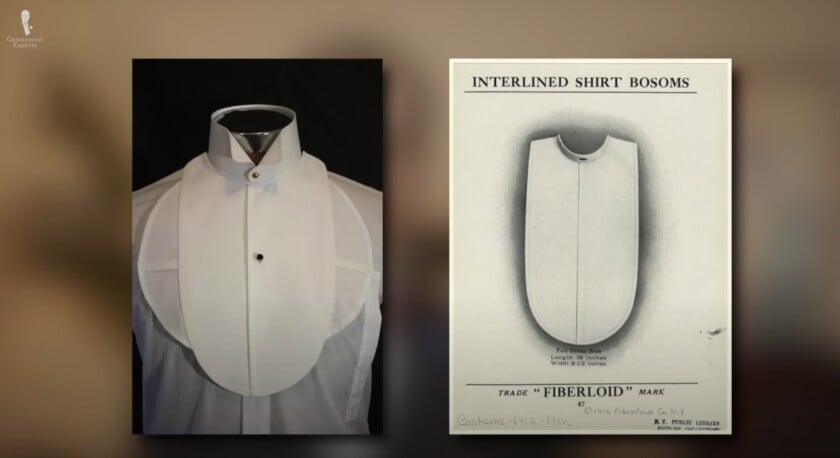
Once home washing machines and reliable running water spread after the 1920s, it became simpler—and cheaper—to launder the whole shirt, so detachable collars lost their purpose.


2. Changes in Collar Style
Victorian style prized tall, rigid collars that complemented a long, formal silhouette. When the Jazz Age ushered in softer tailoring and lower collars, separate pieces felt archaic. A fold-down collar sewn to the shirt suited the new, laid-back look.
Shirt Collar Styles for Men
3. Starching Became Obsolete
Detachable collars kept their height thanks to heavy starch, applied at home or by commercial laundries. The process delivered crisp results but consumed time and effort.
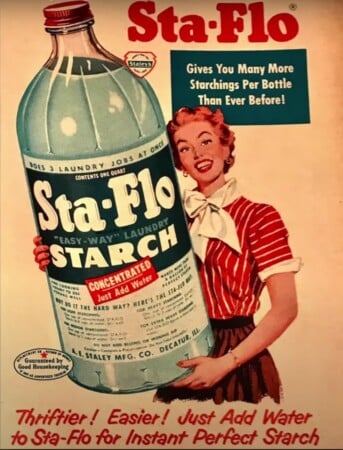
By the 1930s, treatments like “Trubenizing” gave sewn-in collars a tidy appearance without daily starching, and comfort soon beat formality in most settings.
4. Military Practicality Took Over
World War I uniforms featured soft, attached collars—quicker to don and more comfortable in the trenches. Veterans brought the habit home, and civilian dress followed suit, much as trench coats and safety razors did.
Menswear Garments with Military Origins
5. Convenience Won
Fastening two collar studs every morning extended the time needed to get ready. As life became more rushed, this addition to a man’s routine made less sense.

As society prized speed and simplicity, collar studs—unlike visible cufflinks—felt like unnecessary work. By the 1920s, most men decided the impressive look wasn’t worth the daily hassle.
6. Neckwear & Collars Became Optional
In the early twentieth century, appearing in public without a tie or bow tie was “unfinished.” When neckwear lost its obligatory status after World War II, formal collars seemed excessive. By the 1970s, even collar-less shirts appeared in casual wardrobes, pushing detachable styles further to the margins.
The Evolution of Neckwear
Do Detachable Collars Still Exist?
They survive in a few niches: white-tie dress shirts, vintage enthusiasts, and specialty makers like Darcy Clothing, which offers washable versions requiring minimal starch. Yet for daily wear, the sewn-in collar remains the practical choice.
Can You Wear Detachable Collars Today?

In today’s outfit, I decided to try on some of the innovative spirit of the Victorians and converted one of the day shirts in my wardrobe to accept a detachable collar. This shirt, from Hawes & Curtis, featuring attached French cuffs in white for cuff links and also blue-and-white stripes, seemed to be a good fit for the Victorian or Edwardian era.
Looking at vintage fashion illustrations and leveraging tutorials from some of our compatriots here on YouTube—again mentioning Aaron White from Vintage Menswear and Nicholas Hoppe of Vintagebursche—I took the collar off of this shirt. While I have a good amount of experience in hand-sewing and mending, my wife is the one with experience using a sewing machine, so she was able to sew the buttonholes into the collar of the shirt.
For both the rear and front studs, we put pockets in the collar of the shirt so that they don’t go all the way through and irritate my neck; this is a very nice feature. This shirt was a prime candidate for some collar experimentation, as the natural turndown collar that came with the shirt was a bit too large on me, and for a first attempt, I think this shirt actually turned out quite well—but we’ll touch more on that later.
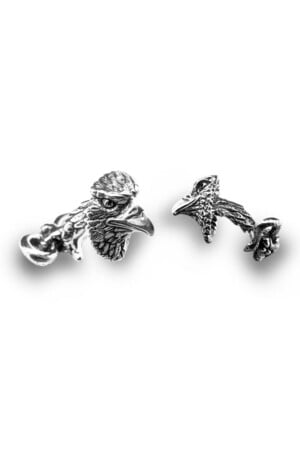
In the cuffs of the shirt, I’ve inserted some cuff links from Fort Belvedere. These are part of our new Predator & Prey series, and they feature an eagle design on one side of the cuff link and a snake on the other. While I haven’t necessarily gone for a fully period outfit today, I did decide to include a few other pseudo-Victorian or Edwardian touches. As such, I’m wearing a charcoal-gray three-piece suit with a bit of character in its weave, and I’ve also accented the pockets of the waistcoat with a silver pocket-watch chain to harmonize with my cuff links.
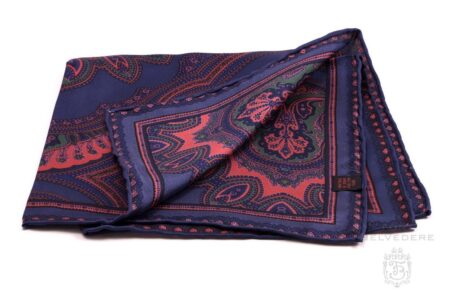
My shoes are split-toe single monk straps featuring silver buckles, and their leather is dark brown but with a reddish undertone in a museum-calf style. My vintage navy-blue silk pocket square features a diamond motif in tones of pink and yellowish brown and a floral motif running around the border of the square.
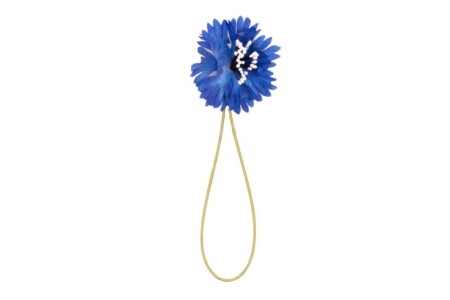
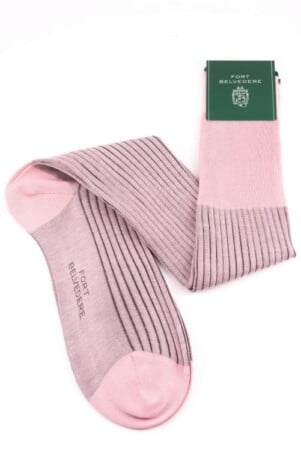
The rest of my accessories today are from Fort Belvedere, and these include my two-toned shadow-striped socks in light gray and pink; my boutonnière, a cornflower design in deep blue and white; and my bow tie, which is also relatively new to our shop—this is in pink tones featuring tiles or medallions in navy blue and white. Rounding things out today is the fragrance I’m wearing, the newest from the Roberto Ugolini collection. It’s called Patina; it features powdery vanilla notes that harmonize together for a very pleasing scent.
So, for the socks, cuff links, boutonnière, bow tie, and fragrance I’m wearing today—as well as a wide array of other accessories, Ugolini fragrances, and corduroy trousers—you can take a look at the Fort Belvedere shop here.


Conclusion
Sewn-on collars are here to stay for most men. Even so, the recent revival of grandad-collar shirts shows how nostalgia can spark fresh experiments. Could detachable collars stage their own counter-cultural comeback? Perhaps! But for now, they remain an elegant footnote in sartorial history.
Would you ever try a detachable collar, or is it best left to history? Let us know in the comments.
Frequently Asked Questions
Why are detachable collars no longer worn?
This style was more popular back when cashing clothing was more difficult and more formal collar styles were preferred. With modern advancements, they became less desirable.
Can I make my collar detachable?
You would be better off going to a specialty maker to get a collar meant to be detachable.
Can I wear a detachable collar today?
You could if you wanted to, though it’s more difficult to find this style of shirt readily available.




Leave a Reply